

Florida marine permitting can feel like a moving target. One agency asks for shoreline details, another wants environmental surveys, and a third may require federal authorization before any work can begin. For waterfront property owners, marina developers, and marine contractors, that can mean costly delays, redesigns, and missed construction windows.
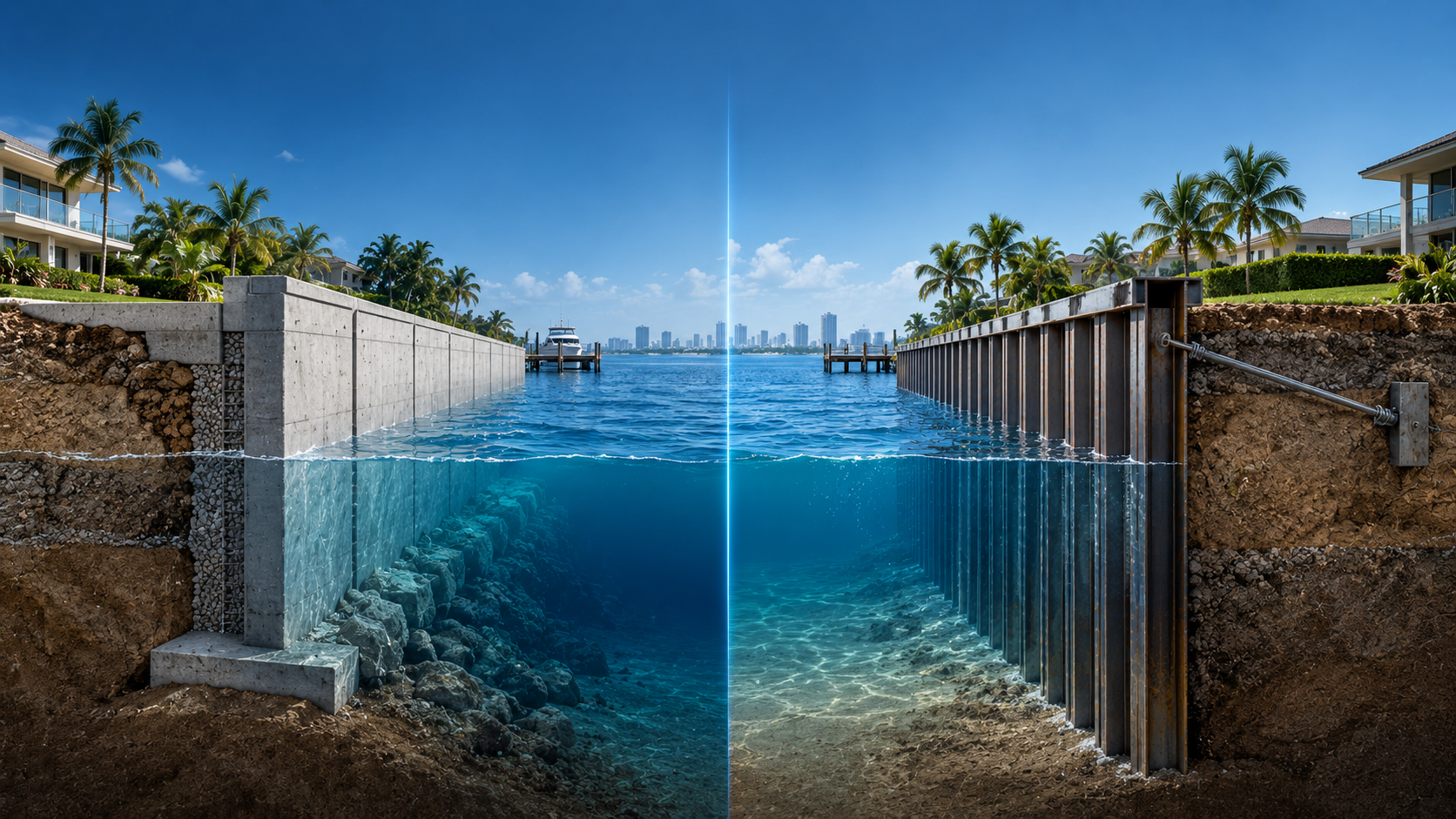
The good news is that the process becomes much more manageable once you understand the Big Three agencies in Florida marine permitting: local governments, the Florida Department of Environmental Protection (FDEP), and the U.S. Army Corps of Engineers (USACE). These are the main authorities that review projects involving docks, seawalls, bulkheads, dredging, marinas, boatlifts, and shoreline stabilization in South Florida and throughout coastal Florida.
Understanding Florida’s Waterfront Authorities
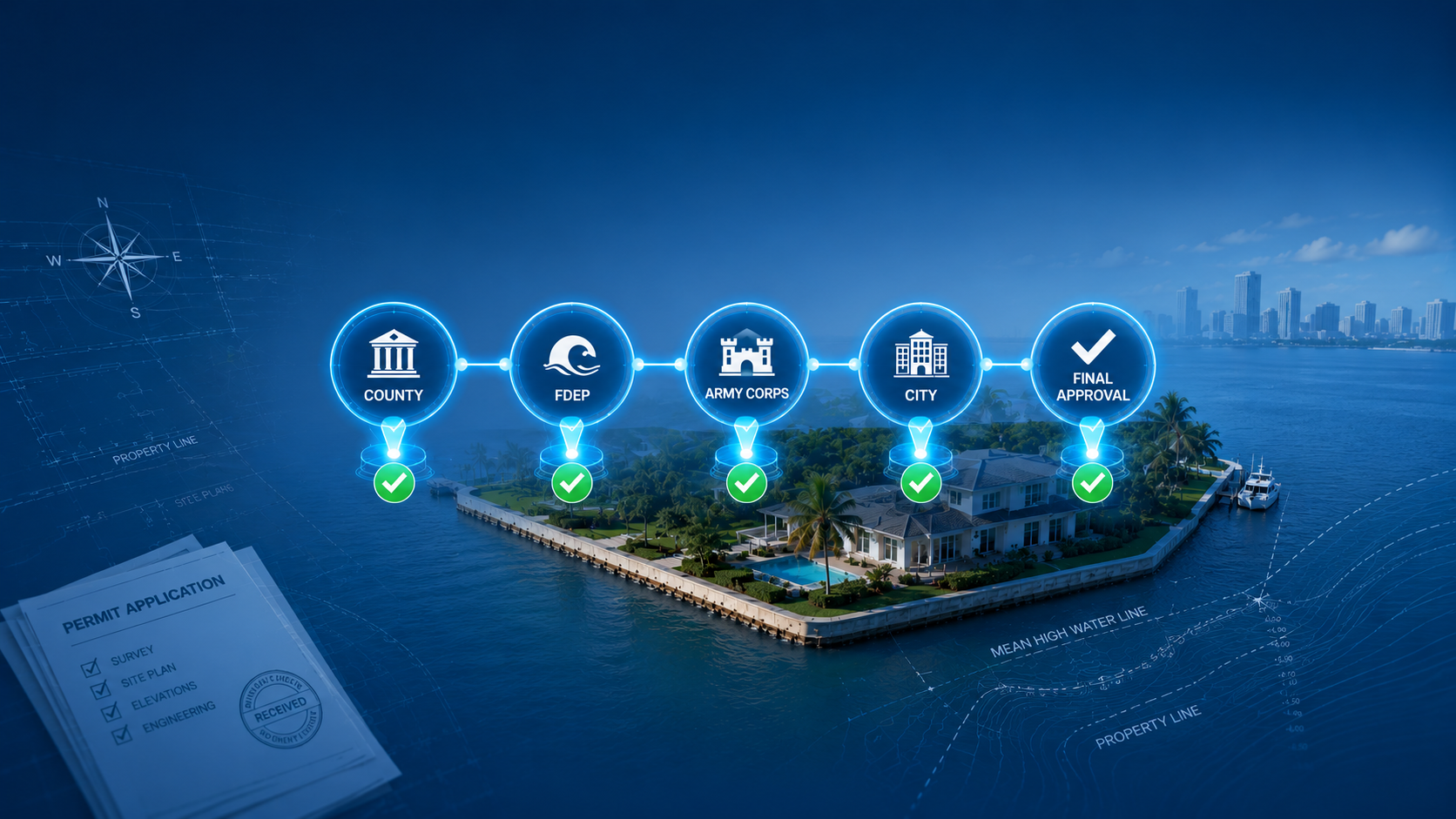
Florida’s waterfront permitting system is built around three overlapping layers of oversight. In practice, that means a project may need approval from a city or county, the state of Florida, and the federal government before construction can begin. Understanding who controls what is the fastest way to avoid rework, redesigns, and permitting dead time.
1. Local Municipalities & Counties (The First Line of Defense)
For most shoreline projects, the process starts and ends with the local government. The first application is submitted to the County, and the last application, after environmental approvals are received, is submitted to the local municipality. These local agencies typically review the following:
- zoning compliance
- shoreline setbacks
- land-use compatibility
- construction code requirements
- coastal development restrictions
- dock or seawall dimensional limits
This is where many projects first run into trouble. A property owner may assume a dock or seawall is allowed because the site has water access, but local rules often control how far a structure can extend, where pilings can be placed, and whether lighting, access, or shoreline features are acceptable.
Local review is especially important for single-family docks, seawalls, bulkheads, and marina concept planning. In South Florida, this early step often determines whether a project can move into state and federal permitting without redesign.
2. Florida Department of Environmental Protection (FDEP)
The Florida Department of Environmental Protection plays a central role because Florida owns or manages much of the submerged land beneath its coastal waters. If your project affects state-owned submerged lands, FDEP may require authorization in addition to environmental review.
FDEP’s primary concern is protecting marine resources, including:
- seagrass beds
- mangroves
- tidal wetlands
- shallow benthic habitat
- water quality
For that reason, waterfront construction projects need careful environmental documentation.
Exemptions, General Permits, and Individual Permits Explained
FDEP permitting usually falls into three broad categories:
- Exemptions: Some minor activities may not require a full permit if they meet specific statutory criteria. These are usually limited, tightly defined, and highly fact-specific. Even when an exemption applies, it must be documented correctly.
- General Permits: General permits are designed for common, lower-impact projects that meet preset standards. This category often applies to certain single-family docks and smaller shoreline structures, provided the design complies with the applicable FDEP general permit requirements and avoids sensitive habitat impacts.
- Individual Permits: If a project is larger, more complex, or likely to affect protected resources, FDEP may require an individual permit. This is common for large marina designs, dredging, major seawall modifications, or projects near environmentally sensitive areas. An individual permit typically requires more engineering detail, more environmental analysis, and a longer review timeline.
This is where experienced coastal engineering consulting becomes critical. The permit category often depends not just on project size, but on bathymetry, resource mapping, and whether the site contains seagrass, mangroves, or other protected habitat.
3. U.S. Army Corps of Engineers (USACE)
The U.S. Army Corps of Engineers has jurisdiction over work in or affecting navigable waters and other federally regulated waters. In Florida, that often means docks, dredging, marinas, seawalls, and shoreline structures that may influence navigation or aquatic habitat.
USACE reviews projects under federal authority, including the Clean Water Act and related permitting programs. For many waterfront projects, a U.S. Army Corps of Engineers dock permit is a required step before work can proceed.
USACE review often involves coordination with other resource agencies, including:
- National Marine Fisheries Services (NMFS), when marine habitat or protected species may be involved
- Florida Fish & Wildlife Concervation Commission (FFWCC), when state-listed or protected wildlife may be affected
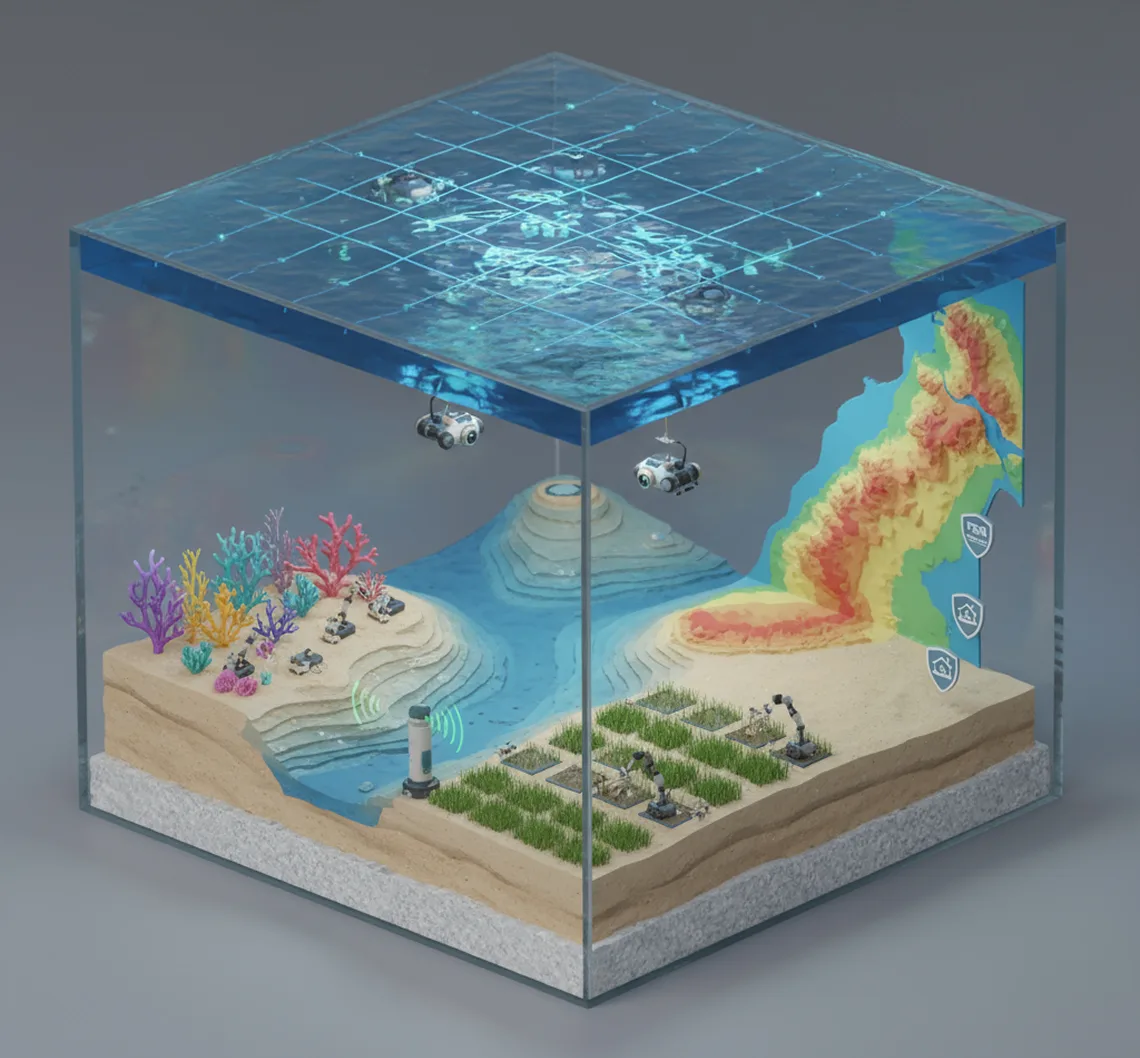
In sensitive coastal areas, a seemingly routine project can become more complex if the site includes protected species habitat, coral colonies, or documented seagrass. That is why submerged aquatic vegetation (SAV) surveys, benthic resource mapping, and water quality monitoring are often essential parts of the early permitting strategy.
What Turns a Simple Permit Into a Complex Review
A waterfront project can shift from routine to highly scrutinized the moment it crosses into sensitive environmental territory. The most common trigger is the presence of coral, which can require careful Coral Relocation before construction can proceed. Seagrass beds create another layer of review because even small disturbances may require Seagrass Mitigation and detailed habitat documentation. Dredging adds further complexity, especially when agencies need to verify exact bottom conditions, sediment limits, and turbidity control measures.
This is where many standard permit applications become complex. A seawall replacement, dock expansion, or dredging project may appear straightforward on paper, but if the site contains coral heads, seagrass patches, shallow navigable water, or other sensitive resources, agency review becomes much more detailed. The permitting record must show that the project has been designed to avoid, minimize, and mitigate impacts to the greatest extent possible.
Why “Doing it Yourself” is the Most Expensive Mistake
Marine permitting is one of those areas where a do-it-yourself approach can quickly become costly. A missed agency requirement, an incomplete survey, or an inaccurate site plan can lead to fines, permit delays, stop-work orders, or even the need to tear down completed work. For waterfront owners and developers, that can mean losing time, money, and credibility all at once.
The biggest risk is not just rejection. It is the chain reaction that follows when a project is built without the right approvals or technical documentation. A dock installed without the proper authorization may have to be modified or removed. A seawall project that fails to account for habitat impacts can face repeated revisions. A dredging project that does not address bathymetry or water quality can be delayed long after crews and equipment are already mobilized.
Hiring a professional removes much of that risk. An experienced consultant understands how local, state, and federal agencies evaluate marine projects, what triggers closer review, and how to build a permit package that anticipates those concerns from the start.
Partner With Ocean Consulting to Move Your Project Forward
With more than 20 years of experience, Ocean Consulting helps property owners, marina developers, and marine contractors move through the permitting process with confidence. Our multidisciplinary team of engineers and biologists manages projects from initial hydrographic surveying through construction administration, bringing the technical depth needed to handle complex shoreline, dredging, and marine habitat issues.